Tuesday, 21 August 2012

South Africa - best team in the world...

It hardly feels like any time has passed since I was at Edgbaston last summer watching England become the number 1 ranked test team in the world.  I was probably very harsh on India back then, claiming that as number 1 side in the world they should be able to compete anywhere and we had annihilated them.  Since then England have proved that actually, there are a lot of really good teams around that can dominate any given series.  England's spell at the top of the rankings lasted just 11 tests (losing 6 tests, 2 series and winning just 3 tests), which included a 3-0 embarrassment against Pakistan... I don't think our batting has recovered properly since then. 

In this series South Africa were clearly the better side.  If you looked at the two teams on paper they appear fairly well matched, personally comparing each position there's only a few positions I'd have definitely chosen someone from one side over the other (Prior instead of Duminy and Smith over Strauss are the two that spring to mind) before the series started, yet the Saffers out played England in every area.  Our usually consistent bowling attack was destroyed at the Oval, 637/2 is an embarrassment, I don't think Jimmy and Broad really recovered from that.  Their batsmen also dug in with 5 centuries between them and 5 people averaging over 50 - compared to England's 2 centuries with the only people averaging over 50 (Bairstow, Pietersen and Swann(thanks to 2 not outs)) not playing all 3 tests.  I don't even want to talk about our catching.

That said... I don't think it was as one sided as it could have been, England did show some battling qualities and actually had small first innings leads at both Headingley and Lord's, however in both cases this was down to an outstanding innings - KP at Headingley and Bairstow at Lord's.  The game at Lord's was a great display of what is excellent about test cricket, could you get that sort of tension and excitement from a T20 game?  Of course not.  

I was at Headingley for day 2 (the day before KP took the fight to them) and England's bowlers looked a lot less toothless than the South Africans.  You always sensed that the likes of Steyn, Morkel and Philander were in the game and capable of taking wickets unlike the English players.

One of the key reasons I felt we got to number 1 was consistency in selection.  We had a settled team who all knew their roles.  Now however, the issue with Kevin Pietersen totally overshadowed the build up to this test.  It is quite clear that he has never been the most settled person in the dressing room, there has long been assumed that there is a rift there but until now they had put up with it for his quality.  I personally can't see him coming back into the set up, which is a shame because he is England's best player and the stats pretty much back that up.  This effectively opens up two spots in the batting order, as England have struggled for a long time to find a quality number 6.  Since Paul Collingwood's last test they have had:

Eoin Morgan (16 innings, 29.60 average)
Ravi Bopara (4 innings, 24.33 average)
Samit Patel (3 innings, 13.33 average)
Johnny Bairstow (6 innings, 37.40 average)
James Taylor (3 innings, 16.00 average)

Bairstow's performance at Lord's seems to have cemented his place in the team, for now, and he does look like a good prospect.  Taylor can count himself unlucky with his dismissal yesterday so hopefully should find himself in the squad for the winter.  Assuming two of these players are in the starting 11 come the first test against India on November 15th then the team will have quite an inexperienced feel to it (as it did for this test) which is worrying when playing in the sub continent.  It may be that Tim Bresnan gets the nod at number 7 instead (9 innings at 39.17) with Matt Prior (26 innings at 41.82) bumped up to number 6.

To put these figures into context, in the same time period Kevin Pietersen averaged 54.23 from 28 innings.  Only Ian Bell's 58.04 average from 29 knocks is better and only Alistair Cook has scored more runs (1425 to KP's 1410).  One person who should really look at his own game considerably is Andrew Strauss.  Since averaging 43.86 in the Ashes tour where Collingwood made his last appearance the skipper has scored just 953 runs in 31 innings at a lowly 30.74 (10 runs less than Matt Prior and only 5 more than Stuart Broad - 25.37 off 22).  Considering Morgan was dropped for his 30 average this really isn't good enough from the skipper.  His leave on Sunday night was one of the worst pieces of cricket I have ever seen and scoring just 107 runs in the series just wasn't good enough.  I don't think he will, or should stand down - I'd like to think he'd carry on until after the next away Ashes tour (2013/14) but he really needs to perform this winter to justify his own place in the team as that is getting harder and harder to do.  

I hope Strauss is correct and they do come back and reclaim the number 1 ranking but they have a lot of hard work to do.  The batsmen really do need to start applying themselves better.  Hopefully they were watching at the Oval when Amla, Smith and Kallis batted for what seemed like an eternity.

Anyway, congratulations to the Saffers - they thoroughly deserve it, each one of their players seemed to contribute at some point and they definitely look like the best balanced team.  I can only see them having problems on the sub-continent but even then their batting should be good enough.  Could see them hanging around at number 1 for a while!

Thursday, 16 August 2012

The leaders debates keep coming back to haunt...

The media seem to love running stories when Nick Clegg had to go back on what he said at the leaders debate because of compromising within a coalition.  I wonder why David Cameron isn't getting as much heat for what he said, even though his reneging is all down to his own party:


For the record, I don't think what was proposed was ideal, but it was a damn sight better than what we currently have.  To my mind failing to reform the Lords is the single biggest failure of the Coalition to date - something all leaders agreed should happen in the leaders debate and the three parties all had in their manifesto, but unable to provide a compromise.  Basically it is times like this that I hate politics.

I know I'm a little behind the times talking about the Lord's, but I didn't really have time to write about it previously and that's why the post is so short!

Fighting a losing battle...

Two days ago I wrote a post about the fact that students erroneously think that they can't afford to go to University and they believe that fees need to be paid up front.  Basically we aren't getting the message across that they wont pay a penny until they graduate, and even then they are still not paying fees until they've effectively paid back the maintenance loan that they were given.  In other words, realistically most students wont start paying fees at all until probably 10+ years after they graduate and even then it'll only be if they can afford it.  I was really disappointed to find buried in the Metro today:

A whole article that does nothing but scare people into thinking that University is unaffordable.  Yes there are costs for students such as accommodation and then boozing etc that they mention but the article is written in a way just to scare.  In fact the more I read it the angrier I get.  It's set up to sound like the fees are payable whilst the student is at university (they aren't), take that away and their headline calculation falls to £27k - the full breakdown of which isn't there, the costs quoted come to roughly £19.5k.  They then make no reference to the fact that students are entitled to a maintenance loan (up to £5.5k a year) effectively from the government - which (as I cannot reiterate enough) they pay back under the same system as their fees.  

Yes there is a gap between the loan and the remaining costs, but nothing a part time job couldn't fix - parents definitely don't need to find £53k that the article implies.  Or alternatively they could stay at home and study at a close by University, even then they are entitled to a loan of up to £4,375 and wouldn't incur anywhere near this cost, or not spend the £4k on alcohol that's quoted.  

If a teenager really wants to go to University then there is no financial reason why they couldn't go to a University.  I don't believe every teenager should be aiming for University, too many I feel are pressured to go when it's not in their (or the economy's/society's) best interest, however none should be scared off for financial reasons.

Wednesday, 15 August 2012

Everything that's wrong with football...


Short-termism at it's very worst.  Prepared to risk a clubs long term security for fleeting success.  Colossal remuneration for a player that isn't even proven to provide success.  

I can see why Big Sam wanted Andy Carroll, he does fit his style, as does Matt Jarvis, the two together should be an effective partnership.  But £17million and £100k a week for someone who's only scored 38 goals in 133 club games seems excessive for a big club with good finances, let alone one that's only been promoted this season and was struggling financially.  "The Manager really wanted him" should never be an excuse, they are the people with the financial experience, I'm sure the Manager would love Lionel Messi in his side, but their job is to tell him that they can't afford to bring him in.

David Beckham comes with his very
own logo.
I'm not one of these people who claim that all footballers are overpaid.  If you look at their Marginal Revenue Product (MRP) some are actually underpaid for the value that they bring to their clubs... however lots are overpaid as a result of this.  They see stars who bring in lots of money for their getting paid large salaries so they expect to receive them too.  (Think about it would you be happy if your colleagues at work were getting paid multiple times that you were?)  Back in 2003 David Beckham signed for Real Madrid for a cool £24.5 million.  A year later he had already accounted for over 1million shirt sales, in fact around 50% of shirts sold in that period by Real Madrid had "Beckham" and the number "23" on their back.  This is in addition to his contribution on the field as well as other merchandising and the additional attendance from having stars like him in their side, all of this meant he had a higher MRP than almost anyone in world football so deserved his high salary.  The difference here is Real Madrid could afford to pay this because of the income they were able to generate and he had more than that value to the club.  I doubt Andy Carroll could create an additional £100k a week for West Ham as well as repay the large transfer fee.  

Living beyond their means has already hurt so many clubs, Portsmouth for example, are currently having to field basically a youth team after years of chasing glory left them in liquidation and they had to release all of their senior players.  It's not just confined to England, up in Scotland one of the biggest clubs, Rangers, are currently starting life in the bottom tier of their professional football leagues after they were demoted following liquidation. 

If a team can win a competition and then play in Europe the
next season, getting a huge increase in revenue as a result and
still go bust, something is wrong with the system!
For some reason many football clubs think racking up debts that they will never be able to afford to pay is a viable way to run a business, it isn't.  This spending is not sustainable - creditors like HMRC shouldn't allow any delay in their payments.  I find it remarkable that they let some of these clubs build up such high debts in the first place, paying tax and national insurance should never be optional.  Nor should smaller local suppliers have to suffer because clubs owe such vast amounts to each other and their stars whom apparently get priority.  

I think UEFA's fair financial regulations are a reasonable start, but I worry they don't really have any bite.  I would like it if the Premier League or FA also introduced something to ensure that clubs couldn't live beyond their means as to my mind, looking at plenty of club accounts I wonder how they can seriously be treated as going concerns.  I don't think the English leagues have been strict enough with those clubs that have gotten into difficulty, perhaps Scotland got it about right with Rangers, but maybe they should have had to start from scratch?

Tuesday, 14 August 2012

Political point-scoring is not worth damaging a whole generation of youngsters...

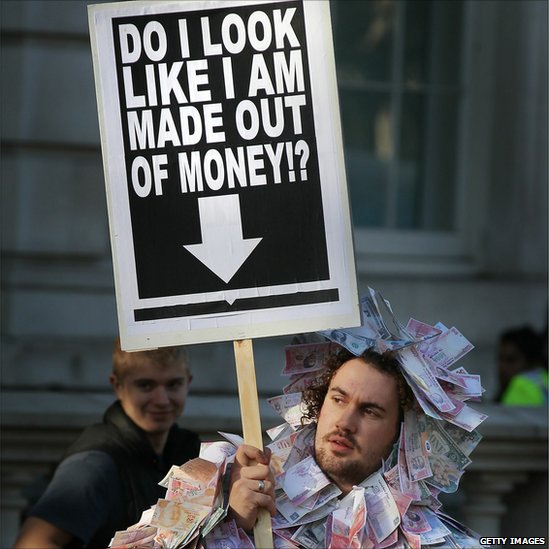
(You would only end up paying the fees
if you were made of money!)
Throughout the Tuition Fees debate it was a constant worry that the rhetoric being used would convince students that they couldn't afford to go to University, they would see that fees were going up and assume that this meant they would need a lot of money in order to be able to get a place.  All of this (of course) is simply not true, not a single penny is paid in fees (unlike when I attended after Labour first introduced tuition fees) until after graduation, then it is paid back on an income contingent loan - students only paying back a proportion of their income after they start earning £21,000 (and then it's only on the additional earnings above this amount).  When you consider that they also receive a maintenance loan in cash whilst they are at University, they effectively have to repay this before they've paid any fees whatsoever, many many years after they finish.  It is therefore really worrying that:


(London Evening Standard)


As far as getting the message across, this would indicate that we have failed.  Argue all you like about whether the Lib Dems should have agreed the increase given their pledges or the relative fairness of the contribution that the student should make to the cost of university but this system is actually more progressive (as those who pay most will be the highest earners after graduation and there is no requirement to ever pay it off if you don't earn enough.  Not only this but students are better off for it when they need it most as because of the higher fees they also get higher grants and maintenance allowances than could be afforded if they were never to contribute to their fees.  In other words they receive more money from the government (based on parents income) than their counterparts in Scotland whilst they are studying, to help them - they are just expected to contribute more back once they earn enough.  All that keeping fees at £3k really does is benefit the future bankers of tomorrow - but obviously Labour and the NUS doesn't want to spin that message - we need to start getting our message across.  

Now it's time to leave a legacy...

I have to say, I was sceptical about the Olympics being held in London, well maybe not sceptical but definitely not as enthusiastic as I could have been.  I'm quite a big sports fan really, I follow quite a few (Cricket, Football, Tennis and F1 in particular but any major event that's going on), however I had absolutely no desire to actually buy Olympics tickets.  I think for me it was the way they came out that put me off... I didn't want to be entering a ballot or anything, if it had been first come first served then I probably would have gone to something that I was interested in.  In addition to the way they were released other things had made me worry, from the logo to the mascots all of the marketing seemed poor in comparison with Beijing four years ago... one couldn't help but be braced for disappointment.

As soon as the games started though it was a joy to watch, all of my pre tournament fears melted away and seeing such a marvellous event being run so smoothly made me actually feel proud to be British!


It's no wonder people wanted to be
there with such spectacular performances
It was incredible how every stadium looked fit for purpose and top of the range, the transport network seemed to cope remarkably well, the BBC's coverage was exceptional (although shamelessly partisan) and I've not heard one bad word said about the volunteers or the security there.  (Though it does worry me how easily we accepted the thought of armed guards around our capital).  Yes there were some empty seats to begin with, but it seemed like the organisers acted pretty sharply to sort it out, and every session of athletics I watched it didn't look like there was an empty seat in the house.  In all I think the games really showcased what is good about Britain, to my mind this was a welcoming, multicultural celebration to which we invited the whole world, irrespective of differences and helped demonstrate that things are much better when we work with each other rather than against.


Everything about the games for me showcased what was promised in our bid - that it was for the people.  Four years ago we got an excellent display of state power from the Chinese, it was really impressive what they could do, but I was equally impressed with how this was put together for the people.  Right from the lighting of the Olympic Cauldron (by 7 promising young people rather than a famous name and this being split into sections, one for each country), right up to the closing ceremony that was one big party.  I was critical of the latter at the time as I don't think all of what was on display was the best of British, but the theme I think was good and they finished with The Who so I shouldn't really complain.

The real challenge however starts now.  
I don't think I've experienced previously the sense of togetherness and enthusiasm that we've had over the past few weeks as a country.  Every other Olympics you get a bit of it but are detached somewhat by it being in a remote place, Football always seems to start with optimism that fades away into misguided anger that we aren't as good as some other countries.  Perhaps the only time I can remember something similar (I was a little too young still in Euro 96) was when we won the Ashes in 2005.  In many ways, England and Cricket have been seeing some of that reward over the past 3 years... but did they really make the most of it?  Now unless you have Sky you only get to watch a small highlights package on Channel 5 any time England plays, even as a cricket fan I forgot that was on earlier this summer.  Over the past year England definitely haven't pushed on as they might and the worry is that they could slip back into the pack.  


Australia's Medal Decline
For however badly this piece in the Independent is written there is possibly a good underlying point hanging around somewhere (and I know the writer was aiming for a couple of other points but I don't wish to comment on what news agencies feel are priorities).  In 2000 Sydney hosted the Olympic games, 12 years on, when they should be reaping the rewards of an inspired generation they picked up fewer medals and finished lower in the table than they did at Atlanta back in 1996.  I doubt anyone expects us to repeat this success without home advantage every games, but I guess the idea is that there should be an improvement now than the overall trend.  It would be foolish to think that the buzz that Team GB along with the organisers have created will last forever (so people are correct to think it will eventually fizzle out), many of our stars of last week wont be recognised on the streets next week but if they have inspired the next generation then they'll have done their job.

Anyway I have to finish this post by celebrating the success of Team GB's athletes.  The overall performance was one that the whole nation should be proud of, we have some very talented and dedicated individuals - so let them celebrate their success:


I bet so many would like to have been a part of that... any ideas how I can get to Rio?

Wednesday, 4 July 2012

"Learning from the past" by continuing to make the same mistakes...

Nicotine, a socially acceptable drug.
Ken Clarke yesterday commented on the the UK "Plainly Losing the War With Drugs".  I've written and spoken about this topic more times than I can remember but for me the reason we are 'losing' the war is that politicians and the media are fighting the wrong war!  Instead of being in a war against drugs we should be fighting the harm that drugs cause.  I feel another rant starting...

Far too often people speaking on the topic talk about minimising drug use, but this isn't where most of the harm occurs.  If all of the casual users stopped tomorrow would you see a fall in crime or drug related health problems in people?  I doubt it, the people with habits will continue to use because they need to.  As long as their drug use is seen as a criminal problem and not a health problem it is much less likely that they will seek the help that they need.

A few things that Mr Clarke said I find quite interesting:


"My purely personal view is I'd be worried about losing the deterrent effect of criminalisation on youngsters who start experimenting. The really key thing is to work out what can get fewer young people to start experimenting with drugs...
"One thing that does put them off is they could get into trouble with the police if they do it. Once you tell them they won't get into trouble, I've always felt that more of them would experiment."


In my experience, it being a crime doesn't stop young people experimenting.  Just looking around the people I personally have known over the years, plenty have tried at least cannabis, yet very few were what I would define as drug users.  It being a crime didn't stop David Cameron himself trying cannabis, even with his political aspirations - although he apparently 'didn't inhale'.  (Even back then just wanting to seem to fit in).  It also apparently didn't stop: 


That's just all that I read in one article.  These aren't ignorant people, unaware of the risks involved, both criminally or health wise, and they all turned out fine (well except for perhaps Tom Spencer when it was a case did have an impact on his political career with it being a smuggling issue).  Whereas had they been criminally convicted at the time of the incident then it would have tarred their futures and they probably wouldn't be where they are today (in some cases perhaps that'd be a good thing?).  

Young people in particular will always experiment, they will always push against their boundaries to learn from themselves.  Just because an authority figure says that something is bad doesn't mean that they will believe them, especially when they see the hypocrisy surrounding it.  In fact, I'm sure plenty of young people try them because an authority figure tells them that they can't!  

This statement also has the working assumption that all drugs are bad, despite it being pointed out on numerous occasions that only a handful of drugs are actually more dangerous than cigarettes or alcohol.

More from Mr Clarke:

"We've engaged in a war against drugs for 30 years. We're plainly losing it. We have not achieved very much progress.  The same problems come round and round but I do not despair. We keep trying every method we can to get on top of one of the worst social problems in the country and the single biggest cause of crime."


This is what keeping supply on the black market achieves.
Firstly, if drugs we legalised, how much of that crime would fall away?  Just what proportion of the cause of crime that he's talking about is in relation to the cultivating, supplying/distribution and possessing of the drug.  Yes, where drug dependency forces users into crime to fund their habit this is a problem - but are these people more likely to be able to break from their criminal behaviour if their habit is illegal?  I can only see that happening once they are in jail (and since 7 percent of heroin addicts try it for the first time in jail* even then they may not break from the cycle).  How much of the violence that drugs creates due to rivals vying for the same distribution channels, trying to get their share of the high profit margins from operating in the black market?  How much of these high profit margins would still be there if a legal (and taxed) market still existed?

Secondly, why is it a social problem?  Is it because addicts are shoved into the margins of society, hidden away rather than helped?  Does criminalising these people help them out of the shadows of force them into there in the first place?  

Finally, Mr Clarke says that they keep trying every method, however the only methods that they are trying relate to prohibition and never evidence based policy.  If we are to ever reduce the harm that drugs can do to people's lives, to communities then I feel that we really need to look, as a minimum at evidence based legislation, with decriminalisation and then legalisation being the better steps.  

Professor David Nutt (who I often reference when talking about this) has written another excellent blog post after recently giving evidence to the parliamentary select committee.  He makes many excellent points, but I in particular agree with one of his opening comments:

"I strongly believe that we should focus on public health approaches to the drug problem, and decriminalise the possession of drugs for personal use, for the following simple reason;- If users are addicted then they are ill, and criminal sanctions are an inappropriate way to deal with an illness. If they are not addicted then criminalisation will almost always lead to greater harms to the user than the effects of the drug."

Overall my personal opinion is best summed up as:

The sooner we let our drugs policy develop beyond "Drugs are bad - because the media says so" the better
(Shamelessly stolen from @mynameisedd on twitter)


*Link is on the Sun's report on the same story here. (I don't like to blindly link people to News International).