Showing posts with label Economy. Show all posts

Wednesday, 21 March 2012

A Budget for the millions, not millionaires‏?

To be honest I was a bit underwhelmed by the budget, people said it was risky but I finished watching it and didn't really have too many points that I wanted to talk about! 

Well you can see what Nick Clegg and the rest of the major Lib Dems want to big up - from Cleggy's email to the party: 


"As a result of this Budget, someone working a full week on minimum wage will see their income tax bill cut by over 50% compared to under Labour.

Increasing the personal allowance to £9,205 takes us within touching distance of our number one manifesto pledge – ensuring no one pays any tax on the first £10,000 they earn.

Thanks to our changes, a basic rate taxpayer will be paying £45 a month less in tax than they would have been under Labour."

You can understand why, it's seen as the major Lib Dem "win".  Announcing the largest increase in the personal allowance, taking it really close to our (arbitrary) target of £10,000, is a really good, positive move for most working people, taking even more people out of tax all together.  It's also really expensive to do for a Chancellor so it is impressive that we've managed to get Gideon to agree to it...

The problem is it doesn't really look like we've had too much else back, not long ago there were claims that we would definitely not reduce the higher rate of tax from 50p to 40p or 45p in the pound, hell our conference even confirmed that, yet just a few weeks later we have.  The problem here is tax avoidance wont definitely come back down as the tax rate does, it's sticky - people wont suddenly get morals.  However they obviously believe that their new measures will bring in more money overall from the wealthiest, which is the important thing.  This isn't thought the best political move, it allowed Ed (or Wallace - I'd rather they didn't get into childish name calling, they should be above that) to ignore the better things and focus on this as an ideological benefit to the rich. To be honest, even with the supposed overall increased take from the wealthy as lets face it not all of the wealthiest will be effected by the stamp duty or the anti-avoidance measures - lots will get a huge tax cut!

The child benefit change (will be tapered down once someone in the family hits £50k) is also not great as still a couple who both earn £49k will still get the benefit whilst a couple with one earner getting £60k will not.  Now I know that this is difficult to administer and yes when benefits are universal it means those who need it are guaranteed to get it but to be frank, I don't see why a couple with earnings of £50k would need child benefit!  That's a couple with above average take home and I wouldn't prioritise them as people to help.

One interesting change is the removal of the change in the personal allowance to those over 65.  I guess you can only look at this as a whole, yes their allowance wont be increasing as much as expected, however at the same time they will be getting a greater amount of income. 

The other good news in brief:
  • Growth for 2012 revised up slightly (despite Labour claiming we're heading into another recession).  It's bad to look at forecasts further than that - for evidence just check 2007's budget.
  • Borrowing £1bn lower than predicted.
  • Reduction in the corporation tax rate.  This really will help millions of companies and is consistent with the policy of reducing the taxes on income in favour of wealth - which most Lib Dems are in favour of.
  • As an accountant this isn't great news for my profession as it will lower some fees however it is good for very small businesses - they can now report their profits on a cash basis.  I wouldn't surprised if most people missed this but it will make things a lot easier for those companies - I'm amazed how few people understand the accruals concept.
  • Increased transparency with regards how the government spends "your" money - however I'd prefer they just asked the media to publish it as surely it'll cost HMRC to distribute it.
Apparently it was a revenue neutral budget and I agree with Nick:

"Of course, this is a Coalition Budget and we did not get our own way on everything. Conservative priorities are not ours."

However less so on the next sentence:

"But as on so many other issues, we have made sure that there is a real Liberal Democrat stamp on this Budget."

Overall, yes there were some good things, however I don't think the poorest will be best off, working people who don't get tax credits will be, the reasonably well off may be hurt a little, some well off will be hurt a lot, however some millionaires will be better off!

Friday, 6 January 2012

The Great Business Confidence Gap

There was an article on the BBC's website the other day "Go Figure: The Great Business Confidence Gap" which tries to ask how business leaders can be optimistic about their own companies future performance whilst being pessimistic about the state of the economy.


For me the reasoning's ridiculously simple, when judging their own fortunes they are close to the figures, they know their details, the issues that directly effect their company.  For the wider economy however, they rely on the media which are much more likely to publish negative stories as this is more likely to sell papers and get people interested.  As such they know the risks that directly effect their business and how to combat these, as well as what opportunities they can capitalise on.  


I speak partially from experience.  The company I work for is likely to have it's best year in 10 years for 2011 (figures to be finalised).  It doesn't appear that 2012 will be quite as good, however the contracted work we have already locked in suggest no reason for alarm.  


There are very logical reasons why people fear for the future of the Economy and why confidence here has decreased - mainly Europe.  To be frank, when Greece were the problem there wasn't much of a problem, as Greece only accounts for under 2% of GDP of the 27 European countries (about 2.5% of Eurozone countries).  Yes, the problems there were hard for the people there, however the wider impact should be limited.  In fact, Greece, Ireland and Portugal combined account for under 5%.  If you think of this as a single economy then this is totally manageable.  However, in recent months we've seen the increased instability in the Italian economy - this accounts for a much bigger problem (around 13% or 17% respectively).  It's no wonder that business leaders may think other companies could be effected by this, but many realise that this isn't a huge risk for their own company.  


Most businesses are actually in good shape.  Back in 2008/2009 many made redundancies as their profitability crashed (even though lots were still profitable), and since then rather than make investments they have retained cash within businesses.  Over in America the non banks in the S&P 500 have over $2 TRILLION sitting in their banks, the highest ever level. 


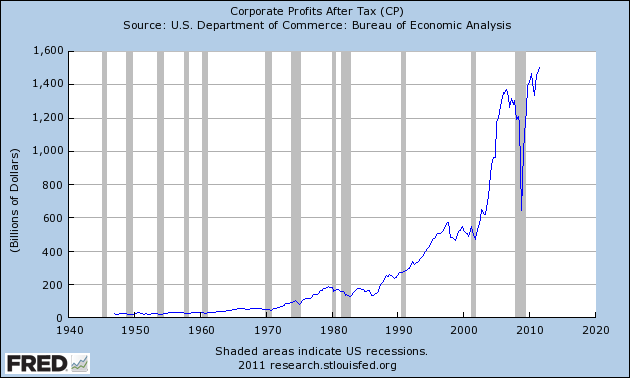
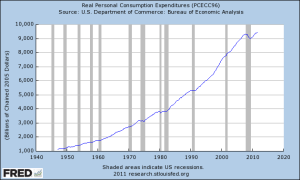
Keeping with America (I can't find details for UK/EU), corporate profits are at their highest ever level as is consumer spending.  After all, although unemployment levels are far from ideal, these tend to be people who usually fill lower paying jobs.  


Given that there are large numbers of unemployed it means that if a business is looking to recruit then there are large numbers of applicants for any position, meaning their wage demands aren't as high as they would have been had the crash not occurred, increasing the flexibility for a company.


Given what I've said above, I'm not worried at all about the US economy for 2012 and this tends to drive the global economy.  The major worry for the UK is our proximity to the EU - Cameron's "bulldog" approach in December will do nothing to help this.  If the European countries can keep themselves afloat then I see no reason for a business that is currently healthy to be worried about the future - although that's not what the media will tell you.

Wednesday, 20 April 2011

The US debt downgraded...

For all those people who think the government's current deficit reduction is incorrect maybe they should look over to the US.  There, indecisiveness is taking hold as a budget fails to go through congress.  As such ratings agency Standard & Poor's (S&P) have downgraded the outlook for the US debt from "stable" to "negative".  This means S&P estimate that there is a 1 in 3 chance that in the next 2 years they will downgrade the country's credit rating.


"More than two years after the beginning of the recent crisis, U.S. policymakers have still not agreed on how to reverse recent fiscal deterioration or address longer-term fiscal pressures"

 The US is now the only one of the 17 countries with an AAA rating to have this outlook.  The response to which was a fall in the FTSE as well as the Dow Jones.  


The UK's position remains as stable.

Tuesday, 1 March 2011

House price conundrum

The weekend debate over on the Lib Dem Voice this week was on house prices - should we want them to go up or to come down?  I am unsure whether or not I can look at this objectively, as it is in my best interests that they fall.  I am a mid 20s professional with no realistic hope of being on the property ladder any time soon.  That said one of the main reasons for this is the area where I have chosen to live.  I can't imagine house prices around the Bath area falling no matter how much national downward pressure is applied.

Thinking in general however I still can't see past price stability being preferable so in real terms prices are declining.  I feel personally is that a major problem in this country has been the reliance on debt where often property has been used as collateral to fund an unsustainable standard of living.  At the same time it is too hard for others to get their first foot on the property ladder, this helps to maintain the inequality in society.

The key ratio is house prices to earnings, the graph illustrates how over the last 10 years this increased ridiculously and even the crash of 2008 didn't bring this down to it's previous level.  In the current economic climate pay for the majority of people is remaining constant or even decreasing so any increase in house prices would push them further out of reach for a lot of people.


The problem is there will always be demand for housing and in an unequal society such as ours even when the majority of people cannot afford the prices there is always likely to be someone willing to pay the price, whether they see it as an investment or a way to obtain additional income.  The only way I can see this changing is if policies are put in place to increase the supply of housing (more supply - lower equilibrium price) or to put restrictions on home ownership where people do not reside in the property, this however would penalise renters.


There is also the problem that if house prices fall then people could find themselves in negative equity, this can have disastrous effects on families and as such could not be desirable.  


No matter what happens there is always winners and losers.  Falling prices can have disastrous effects on people's lives where as rising prices helps to form a clique of home owning elite.  That's why stability where over the long run the ratio falls back down towards the more sustainable 3-3.5x earnings is what I would find more desirable.  However I can't see this happening.

Friday, 11 February 2011

Twitter is not the best place for economics debates

One of my good friends (former Lib Dem voter now supporting Labour) and I have been trying to have a debate on Twitter regarding the government's spending review/prospects for growth in particular he didn't agree with my blog Debt vs Deficit. I don't think Twitter is the best way to articulate arguments - I was finding myself frustrated when one sentence was taking up the allotted 140 characters so I shall summarise here.  The gist of his points are (feel free to correct me):
  • Cutting now reduces jobs which reduces tax income and increases the benefit bill.
  • He would rather give companies tax breaks to increase jobs before reducing government spending as this will increase tax revenues.
  • The Coalition are destroying the welfare state "and leading us to a country where their will be a vast gap between rich and poor"
  • Jobs are part of the way out, Gotta include regulation on banks and closing tax loopholes to stop it happening again.  (I don't think anyone could argue against this!)
  • I sound like a Tory when I say the welfare state provides incentives not to work.
Now I consider him to be a socialist (he says "Social Democrat") and full of good intentions.  There is a lot of what he says in general and in the discussions we have had recently that I agree with.   I am going to use the below to spell out my argument for continuing on the current course of action however I must emphasise that I don't agree with every adjustment that has been made in the spending review I just believe that the reduction needs to happen (and should happen quicker than the current government is doing).

Firstly, let me say the easiest thing to defend for me is my statement that the welfare state provides incentives not to work.  I think it's clear by providing unemployment benefit and other support (housing allowances, free school meals etc) there is an incentive for certain people not to work as their marginal cost of working is higher than the wage that they will bring in.  That does not mean that I think the welfare state shouldn't exist, mealy that the incentive exists.

I don't think there is an argument about weather the deficit needs to be reduced, and hopefully there isn't an argument that we need to start running surplus's.  Back in 2007 we were paying around £28bn a year in interest, this year we will be paying over £40bn and by the end of the parliament, despite the harsh measures that will be put in place we will be paying an estimated £63bn.  This is money that we are not getting back, money we have to spend in before we can run a surplus to bring down the debt level and reduce future payments, hence money we are not able spending in future on education, health care - unless we keep borrowing more and getting ourselves further into the shit.


Our disagreement obviously boils down to how this reduction comes about, although I think I place a much greater importance on the reducing the debt as I see this as something potentially catastrophic.  He is quite right in suggesting increasing government spending (G) as in normal situations an increase in G would normally result in a larger increase in GDP due to the multiplier effect that this spending has (directly increasing GDP and then filtering through the economy).  However I don't see this as a normal situation.  The mountain of debt is so large leading to consumer confidence and investment confidence being so low that I don't think increasing spending will have a positive effect.  Consumers don't have the same propensity to consume (they also have less access to credit) and Investors will get nervous and demand higher interest rates or withdraw from the economy.  

I also feel that there has been so much waste in spending by Labour, spending for spendings sake that there is plenty of functions that aren't fit for purpose and as such should be scaled back.  I also don't think that governments can create wealth, they should be there merely to redistribute and ensure the vital services are provided for everyone.  Government run institutions aren't efficient, my thoughts are the cuts will help to readdress this and bring their spending to more realistic levels.  The private sector made massive cuts in the wake of the crash yet there wasn't a huge effect on jobs. 

Like I've said, I don't agree with everything in the spending plan, but do subscribe to it's overall goals.  I would do things differently of course, but who wouldn't given a chance to implement their own ideas.  The thing is, although I am supporting it, I do think we need to be flexible.  I think it will be the right way to go for the whole parliament but if it is having terrible effects on the people on the street then we should look again.  I for one don't give a shit about the growth figures (the final quarter's figures were nothing to do with government cuts, just things out of their control) what really matter is the ramifications for the ordinary person.  People will be squeezed yes, but can they cope?  I think the 2012 budget will probably need more to ease the burden on those less well off whilst more policies are still needed to help improve social mobility.
Oh and one final point, inequality grew over the 13 years Labour were in power, I think the vast gap already exists!

Thursday, 10 February 2011

The Banking problem...

David Boyle over on The Real Blog has just written a very good piece in relation to the Lord Oakeshott resignation and 'Project Merlin'.  In this piece I think he has hit the nail on the head with his assessment of what is wrong with our banking system:

The real problem is this. It isn’t that banks are somehow unwilling to lend money to small businesses; it is that they are no longer set up to do so. They have no local managers empowered to take decisions. They have risk software that rules out most deals. They have such onerous conditions and charges that many SMEs shun them altogether.

I couldn't agree more.  I see this first had with the company I currently work for.  I don't really wish to go into details on our business but we've been in discussions with a major bank for nearly a year.  At local level they are very enthusiastic (as the fees that they would charge us for the service are quite significant) however we are yet to hear anything back from national level.  They are currently now waiting on our year end results and although I can understand the caution it is really frustrating as it limits our ability to grow.  We are not a company in trouble, just one that in order to finance the big contracts at the start we need to be able to receive the advances that come with them and for that we need bank guarantees.  We also pay a fortune for this privalage as well as them holding on to 20% of the advance as security.

I also see the very large charges that get placed on us by our existing banks, mainly due to the large number of accounts that we need.  In addition as a Euro trading company lots of our facilities are in Euros however they insist on charging us in sterling so they convert the amounts at a rate that is often worse than we would get in the open market. 

Most banks we have spoken to assume we are too risky without understanding how we work and those that do understand it at local level and realise why there is little risk and potentially large reward aren't able to feed this through the chain as it's simply not needed.  The banks that we currently use know it's difficult for us to go elsewhere and as such can impose obscene charges.  In the end it boils down to the fact the banks don't need our business yet we need them.

Wednesday, 2 February 2011

Debt vs Deficit

George Osborne 'might fail to pay off deficit by election' is a headline on the Independent's website today.  It is headlines like this that help fuel the misunderstanding/confusion around the nations finances.

The deficit is not something we can "pay off", it is the difference between the Government's Spending and it's Income.  At the start of each fiscal year the deficit is £0, this then grows as the year unfolds and the Government spends more than the receipts they collect.  This is what George wants to eliminate before the next election - i.e. to stop spending more than they earn.   Conventional economic theory suggests that it is

The National Debt however is the amount of money the UK actually owes.  This amount is increasing ever year due to the fact that the Government is running a budget deficit.  At time of writing the national debt currently stands at over £900,000,000,000 - not including the recent (necessary) bailout of the banks.  This towers over the 2009/10 budget deficit of £170.8bn and shows why urgent action is needed.  The interest on this debt is over £40 billion a year, which apparently works out to £1,882 per household.

It is for this reason why the media and people like Ed Balls are completely wrong when they suggest we should be delaying reducing the deficit.  Every £1 we spend on interest is not money being spent on schools, hospitals and other services we rely on.  Every £1 we borrow is effectively £1 we have borrowed from future generations that they will have to pay back with interest.  Yes the next few years will be tough, but unless we can at least start to bring down this figure by running a budget surplus we are just putting off the pain until further down the line when it will be a lot lot worse.

George Osbourne will not "pay off" the DEFICIT, as that is not something to pay off, the plan should be that come 2015 we are in a position where we are starting to pay off our DEBT.

Thursday, 27 January 2011

“If you do not have growth, you will never cut the deficit.”

That is a quote from Ed Miliband from this week's PMQ's.  This is absolute nonsense and implies a linear relationship between economic growth and budget surplus/deficit.  Of course, as highlighted by Keynes there should be a positive correlation between the two - when the economy is growing less expenditure is needed/more taxation generated so there should be a budget surplus and when it is in recession governments should stimulate the economy with additional spending.  However if this was a perfectly binary relationship we wouldn't have had years of budget deficit (creating the mountain of debt we already had before the credit crunch) in the "boom" years under the previous labour government.  

There are many examples of how cuts can be made without even impacting on growth at all.  For instance, our international aide (which I am very supportive of) adds nothing to the gross domestic product of our economy, if we didn't pay any of this out the budget deficit would be reduced - growth didn't influence this reduction one bit.  Find cheaper credit for our debt, will reduce our (huge) interest payments and therefore the deficit - again, this didn't come into effect because of growth.

I have always found the obsession with growth rather strange, for me personally I couldn't give a damn if the country is growing or not, surely what matters is the prosperity and living standards of those in the country.  Growth and prosperity are two completely different things.  I also definitely don't see how the Government can generate growth as it only ever spends money taken from it's citizans/businesses (though education could be seen as a growth generator for the future).  Any growth has to be lead by the private sector and private sector investment.  The easiest and most direct method of investing in an economy and then generating the growth (that is so desired) is by giving people and businesses their own money and then allowing them to decide how to invest it.  There are obviously externalities and free rider problems that Governments try to solve but these themselves do not generate growth so I think governments go to far with their spending in a misguided attempt to stimulate the economy, which as a result leads to increased borrowing and higher interest costs forcing them to spend future money on financing at the expense of improving people's lives.

The reaction from the Chancellor was not good enough after the announcement of a contraction of the economy in the last quarter of 2010, he blamed it on the snow.  Yes I'm sure that the snow had some effect, but it wouldn't have wiped off that much of the country's GDP.  Channel 4's fact checker does a lot better job of describing the forces that acted towards this - and also discrediting Miliband's assertion that we are cutting too much too quickly.  It's worth a read.

Friday, 26 November 2010

The IFS answers… Is increasing VAT progressive?

Apparently yes... though my personal opinion is that this is a perfect candidate for John Rentoul's series.

I believe the main argument for it being a progressive tax is that those worse off spend proportionally less of their money on products with VAT attached to them and as such an increase in VAT will cost them proportionately less.

I can see this argument however I don't think this takes into account the actual effect on those lowest earners.

Low earners spend proportionately less on VAT related products because they have less money.  As a result they are on strict budgets, with many spending exactly what they earn each week/month/year and others spending more than that by utilising credit.

Higher earners however have a lot of discretionary spending and as a result are able to save money.  

I would argue that as a proportion of disposable capital available to spend (including income and capital reserves once essential expenditure is taken into account) a poorer person will be spending proportionally more on products with VAT than a more well off person.

Those living on a shoestring as a result are likely to have to forgo purchasing particular products as the rise bites and prices increase out of their range.  Those better off will easily be able to absorb the rise, hence it cannot be progressive.

I still think the Coalition (capitalised according to grammar Nazi John Rentoul as it has been around for more than 6 months) is doing some very positive things for the country but portraying an increase in VAT as progressive in my opinion is completely wrong, no matter what statistical data is thrown at it, the substance of the rise is the material effect that it will have on the real people who will be effected.

Tuesday, 19 October 2010

Spend Spend Spend...

Stephanie Flanders, the BBC's Economics correspondent has posted an excellent blog today.  I normally find her quite informative without always agreeing but this was particularly good.

The gist of the blog is providing a picture of how we have come to be in the position we are.  I think the graph she has included is quite telling.  I would have liked it to provide a trendline up to 1997 as a comparison, I think this would show much lower government spending come 2015 than is predicted.

This is the reason that I still blame Labour for our recession.  I know that this was a global crisis, however if they had been managing our countries finances better then this correction wouldn't be needed.  Labour were lucky enough to come into power in a period of economic prosperity (bar the period around 9/11) the conditions were there for consistent economic growth.  In periods like this the government shouldn't be spending everything that it receives, it should be holding a bit back for the inevitable storm that is to come.  I know I'm guilty of following along with this, as I did vote Labour in 2005 (in a Labour/Tory area).  It wasn't until the 2006 or 07 budget (after long enough studying economics) that I started to question whether Brown was as prudent as he claimed.  For as long as I could remember he had been talking about debt and how it would come down in the future, though it never seemed to.  It was this expansionary policy that has come around to bite the nation quite considerably.

It would be fair enough if we had been saddled with debt but find ourselves with state of the art services provided by the government, however I don't think we have.  The NHS eats money, and is totally inefficient (though fine institution).  Schools have improved in places, but not everywhere.  My mother works in a school, she recently had an office developed for her (was needed but it isn't front line).  She was told it had to cost at least a certain amount, if it was below that amount they couldn't class it as a capital project and get the funding for it (it would have had to come out of the normal budget - which would have reduced what could be spent on front line teaching).  Public transport is laughable.  As a commuter I have to endure delays on a regular basis, over crowded trains and spiraling prices.  The bus alternative would take much longer and just isn't feasible or desirable!  Whilst I applaud the concept of improving services it seems to me that much of these funds were wasted/swallowed up by higher wages, particularly at management level. 

I therefore blame Labour for letting spending get away from them, on things that shouldn't have been priorities (such as ID cards) or inefficiently spent and not saving enough when they had a chance.  If we had been running a budget surplus then we would have had no problems borrowing money to "bail out the banks", with that having the potential to make money rather than costing money.  It would have saved us a fortune in debt financing and we could have used standard Keynesian economics to spend our way out of recession.  It may not have been hitting us as bad, countries like Canada and Australia have come out of this fairly unscathed.  Although this is unlikely with our reliance on the banking sector, the government could have been better positioned to act.

What I have described, what Labour should have done is in an ideal world.  Unfortunately, we have a system where by a new government is elected every at least every 5 years.  Therefore there is no incentive for the party in power to actually practice fiscal prudence.  They know that their best bet on winning the next election is a generous budget (spending lots, taxing little), if they lose it's then on the other party(ies) to sort out.  The Labour government (as I have said before) were only concerned with power and did what they needed to do (or thought they needed to do) to stay in power.  Basic principal agent theory shows that governments will never be perfect, the principal (the electorate) and the agent (the government) have different utility curves/factors motivating them, however I think the way Labour handled their 13 years in power was incredibly short sighted and means I will probably never trust them again.